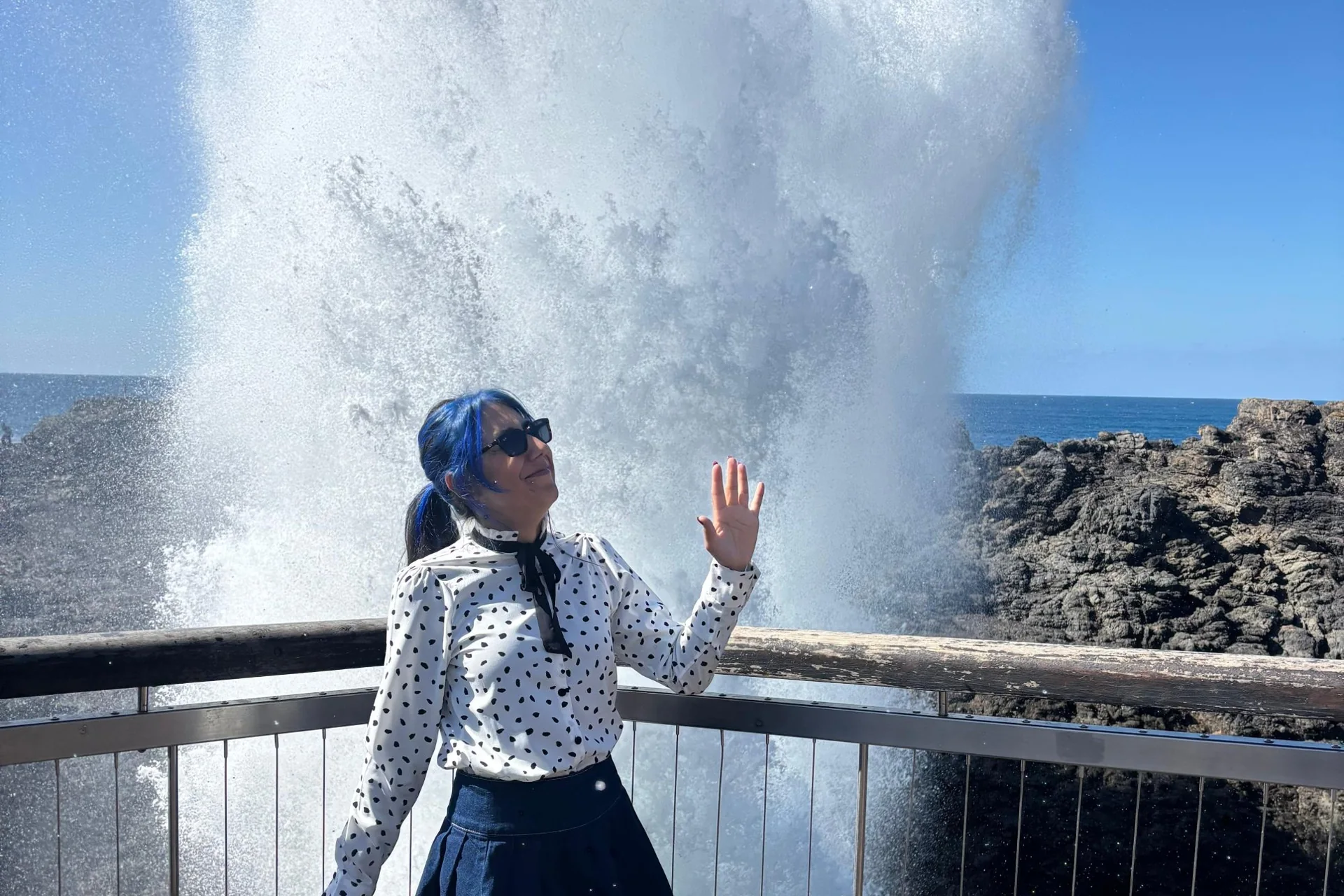
The Kiama Blowhole is a crack in the basalt cliffs at Blowhole Point, right beside the Kiama Lighthouse, where waves are forced through an underground chamber and shot into the air with a deep boom. It’s free to visit, open 24 hours a day, and only about 120 km south of Sydney. For the biggest eruptions, go when there’s a south-easterly swell and wind. If the sea is calm, head 2 km south to the Little Blowhole, which is smaller but far more reliable.
See it on a day trip: Kiama is a stop on our small-group Jervis Bay day tour from Sydney, together with the Sea Cliff Bridge, Hyams Beach and wild kangaroos. Professional photos of your day are included.
That’s the short answer. Below is everything else you need to know to plan your visit: how the blowhole works, what to expect on the day, how to get there from Sydney, what else to see in Kiama, and how to stay safe on the rocks.
What is the Kiama Blowhole?
Kiama sits on the NSW South Coast, in the Illawarra region, and the blowhole is the town’s most famous landmark. The headland it sits in was formed by ancient basalt lava flows, and over time the ocean has carved a sea cave into the rock with an opening at the top roughly 2.5 metres wide.
When a big wave rolls into the cave, water and air are compressed inside the chamber. As the pressure releases, the water is forced up through the opening and out over the rocks. In the right conditions the spray reaches around 25 metres, and the local tourism body says plumes of more than 30 metres have been recorded on strong days.
The local Aboriginal people knew the blowhole long before Europeans arrived. The explorer George Bass wrote about it in December 1797 after sheltering his whaleboat nearby, which makes it one of the earliest natural features on the coast to be described in writing.
When is the best time to see the Kiama Blowhole?
This is the question everyone asks, and the honest answer is: it depends on the ocean, not the clock.
Swell and wind direction matter most
The main Kiama Blowhole performs best with a south-east swell and a south-east wind. That combination pushes waves straight into the mouth of the cave. On a flat day with a light northerly, you might only see a gentle splash and hear some gurgling, which can be a little disappointing if you’ve come a long way.
Local advice is that the tide makes little difference, so don’t worry about planning around high or low tide. Check a surf or swell forecast for the South Coast the day before instead. A decent swell from the south or south-east is your best sign.
The Little Blowhole is the reliable backup
The Little Blowhole is on Tingira Crescent, about 2 km south of the main blowhole. It erupts more regularly and works best in the opposite conditions, with a north-east swell and wind. That means on many days when the big one is quiet, the little one is putting on a show. There’s a small car park and a viewing platform just below the road.
Time of day and season
Because the blowhole is open all day, every day, you can visit whenever suits you. A few tips:
- Early morning is quieter, and the low sun can light up the spray beautifully for photos.
- Late spring and summer (November to February) bring warm weather and the busiest crowds, especially on weekends and school holidays. Aim to arrive before late morning if you want easy parking.
- Autumn and winter are quieter, and southerly weather systems can bring the kind of swell that makes the main blowhole really fire.
If you’re visiting in the coming weeks, spring is a lovely time: mild temperatures, longer days and fewer people than in summer.
What to see at Blowhole Point
The blowhole is only one part of a small headland that’s worth an unhurried 45 minutes to an hour.
Kiama Lighthouse
The white Kiama Lighthouse has stood on Blowhole Point since 1887 and is the backdrop for almost every blowhole photo. The tower is about 16 metres tall and isn’t open for climbing, but the views from the path around it are excellent. The old keeper’s cottage next door houses a small museum that opens on weekends.
Viewing platforms
There are several fenced viewing areas around the blowhole, including accessible platforms. The most easterly viewing point gives you the full height of the spray against the rocks. Stay patient: blowholes come in sets, just like waves, so give it ten minutes before deciding it’s a quiet day.
Kiama Rock Pool and the harbour
Right on Blowhole Point there’s a free ocean rock pool, popular with early-morning swimmers in the warmer months. Walk back towards town and you’ll pass Kiama Harbour, where fishing boats come and go and there are often people eating fish and chips on the grass.
Facilities
There’s parking at the point, picnic areas, public toilets and a café next to the Kiama Visitor Information Centre, which is a good place to ask about local conditions.
How to get to Kiama from Sydney
By car
Kiama is roughly 120 km south of Sydney, about 1 hour 45 minutes via the M1 in normal traffic. The most scenic way is to leave the motorway and follow the Grand Pacific Drive past Bald Hill Lookout and over the Sea Cliff Bridge, then rejoin the highway south of Wollongong. It adds time, but it’s one of the best coastal drives in Australia.
By train
South Coast Line trains run from Sydney to Kiama, taking around 2 hours 20 minutes one way. Kiama station is only a short walk from Blowhole Point, so this works well if you’re happy to spend most of your day in Kiama itself. Check the Transport NSW trip planner for current timetables, as some services require a change.
On a day tour
Kiama sits roughly halfway between Sydney and Jervis Bay, which is why most South Coast day trips stop there. On a tour, you see the blowhole as part of a bigger day rather than as the whole trip, and someone else handles the driving and parking.
Other things to do in Kiama
If you have more time, Kiama has plenty to fill a few hours:
- Kiama Coast Walk: a coastal track of around 20 km between Minnamurra and Gerringong. You don’t need to walk it all; the stretch south from the blowhole towards the Little Blowhole is a good short sample.
- Cathedral Rocks: striking eroded basalt formations about 4 km north of town, best at sunrise.
- Bombo Headland: dramatic basalt columns left by erosion and old quarrying, also about 4 km north.
- Minnamurra Rainforest: inland in Budderoo National Park, with a walk to Minnamurra Falls that’s best after rain.
- The Terraces on Collins Street: a row of historic timber cottages now home to small shops and cafés.
Safety tips for visiting the blowhole
The blowhole is beautiful, but the rock platforms around it are genuinely dangerous. Freak waves have washed people off these rocks, and there have been fatal accidents at the site. Please:
- Stay behind the fences and on the viewing platforms, even if you see other people climbing over.
- Never turn your back on the ocean when you’re near the edge.
- Keep children close and hold their hands near the barriers.
- Expect to get wet. On a big day the spray can drift onto the platforms, so protect your phone and camera.
- Wear shoes with grip, as the rocks and paths can be slippery.
How to see Kiama on a day trip from Sydney
Kiama is a stop on our Jervis Bay & South Coast day tour. We meet at 7:00am in Surry Hills, near Central Station, start with a waterfall near Stanwell Park, then stop at Bald Hill Lookout and walk along the Sea Cliff Bridge before reaching Kiama for a walk around the town and the blowhole. After lunch in Gerringong we continue to Hyams Beach for swimming and snorkelling and wild kangaroos in Jervis Bay National Park, and finish in Berry, home of the famous Berry Donut Van, on the way back to Sydney (around 6:30pm). The order can change on the day with the weather and crowds.
It’s a small group, so there’s time to wait for a good set of waves rather than rushing back to a bus. We also take professional photos throughout the day, with drone footage where flying is permitted, so you can watch the blowhole instead of only filming it.
Want to plan the rest of the day? Read our complete guide to a Jervis Bay day trip, our list of things to do in Jervis Bay, or compare options in the best day trips from Sydney.
FAQ
Is the Kiama Blowhole free?
Yes. The Kiama Blowhole and the Little Blowhole are both free to visit and accessible 24 hours a day, every day of the year.
How high does the Kiama Blowhole go?
In good conditions the spray reaches around 25 metres, and plumes of more than 30 metres have been recorded on big-swell days. On calm days it may barely splash.
What is the best time to see the Kiama Blowhole?
The main blowhole works best with a south-east swell and wind. The tide makes little difference. On calmer or north-easterly days, visit the Little Blowhole on Tingira Crescent instead.
Are there set times for the Kiama Blowhole?
No. The blowhole has no schedule: it erupts whenever a big enough wave rolls into the cave. On a good swell day that can be every minute or two; on a flat day it may barely splash. Check the South Coast swell forecast before you go, and if the main blowhole is quiet, try the Little Blowhole.
Is there a Kiama Blowhole tour from Sydney?
Yes. Kiama is a stop on our small-group Jervis Bay day tour from Sydney, together with the Sea Cliff Bridge, Hyams Beach and wild kangaroos, with a maximum of 11 guests and professional photos included.
How long do you need at the Kiama Blowhole?
Allow 30 to 60 minutes for the blowhole, lighthouse and viewing platforms. Add an hour or two if you want to walk part of the coast track or explore the town.
How far is Kiama from Sydney?
Kiama is about 120 km south of Sydney: roughly 1 hour 45 minutes by car or about 2 hours 20 minutes by train.
Can you combine Kiama and Jervis Bay in one day?
Yes. Kiama is on the way to Jervis Bay, so it’s a natural stop. It makes for a long but very rewarding day, which is why many visitors prefer a guided day tour that covers both.

Founder & Tour Guide, 77Tours · Sydney, Australia · English & Portuguese